


Pickleball Rules – A Complete Beginner Guide

image source:https://pickleball.com/news/pickleball-was-fastest-growing-sport-in-u-s-for-fourth-consecutive-year-according-to-sfia
Pickleball is booming, but the jargon can be intimidating for beginners. The good news? The sport is incredibly easy to learn. This guide breaks down the official pickleball rules—from serving and scoring to the kitchen—so you can start rallying with confidence today. Want advanced strategies first? Read our How to Play Pickleball Article. Otherwise, let’s dive into the essential rules.
1. The Pickleball Court & Equipment
Before swinging a paddle, familiarize yourself with the court layout. The best part? The playing surface remains exactly the same whether you play singles or doubles.
Court Dimensions and Key Lines (20 ft × 44 ft Court & 7-Foot Kitchen)
A regulation pickleball court is compact, measuring exactly 20 feet wide by 44 feet long. The net splits the court in half, standing 36 inches high at the sidelines and dropping to 34 inches in the center.
The court features several crucial lines that dictate gameplay:
Baselines: These run parallel to the net at the very back of the court on both sides.
Sidelines: These run perpendicular to the net, marking the outer left and right boundaries of the 44-foot length.
Centerlines: These run down the middle of each side, splitting the backcourt into left and right service areas.
Non-Volley Zone Line: This crucial marker sits exactly 7 feet away from the net on both sides. The rectangular 7-foot zone between the net and this line is what players lovingly call "the kitchen".

2. Serving Rules
In some racket sports, a serve is a devastating offensive weapon. In pickleball, serving rules are designed simply to initiate play and start the rally smoothly.
The Legal Serve: Underhand, Below the Waist, Behind the Baseline
Under USA Pickleball rules, your feet must stay behind the baseline until contact for either serve:
Volley Serve: Hit underhand in an upward arc. Contact must be below your waist with the paddle head below your wrist.
Drop Serve: Drop the ball and hit it after it bounces, which bypasses the strict arc and waist-height restrictions.
Serve Placement: Diagonal & Must Clear the Kitchen
Your serve must always travel diagonally crosscourt into the opponent’s service box. Keep these landing rules in mind:
The Kitchen Line (Fault): The ball must completely clear the non-volley zone. If it lands short or grazes the 7-foot kitchen line, it is a fault.
Boundary Lines (In): The centerline, sideline, and baseline are all fair game. If your serve hits any of these, it is a good ball.

One Serve Attempt & Service Sequence (Doubles Rotation & Singles Even/Odd)
Unlike tennis, you only get one serve attempt to put the ball in play.
Doubles Rotation: Both partners serve before the ball turns over to the opponents. The only exception is at the start of a new game, where the first serving team gets just one server.
Singles Rotation: Your score dictates your side. Serve from the right on even scores (0, 2, 4) and from the left on odd scores (1, 3, 5).

3. Scoring Rules
Scoring is the one aspect of the sport that usually confuses beginners, but once you play a few matches, the rhythm of it becomes second nature.
How Points Are Scored: Only the Serving Team Scores
The golden rule of pickleball scoring is that only the serving team can score points. If the receiving team wins a rally, they do not earn a point. Instead, they force the opponents to rotate to their second server or win the serve back entirely (a side-out).
Winning the Game: 11 Points, Win by 2 (Tournaments 15 or 21)
Standard games are played to 11 points, and you must win by a 2-point margin. This means if the score is tied 10-10, play continues until one team establishes a two-point lead. While tournaments may play to 15 or 21 points, the "win by 2" rule always applies.
Calling the Score: Three Numbers Explained
Before serving in doubles, you must loudly announce the score using three numbers in this exact order:
1.Your team's score.
2.The opposing team's score.
3.Your server number (1 or 2).
For example, if your team has 4 points, your opponents have 3, and you are the first server, you call "4-3-1". Because the starting team only gets one server, the opening match score is always "0-0-2" or "0-0-Start".
4. The Two-Bounce Rule
The two-bounce rule is what gives pickleball its unique strategic flow. After the serve, the receiving team must let the ball bounce once. Then, the serving team must also let the return bounce once. Only after these two mandatory bounces are players legally allowed to volley the ball out of the air. This prevents the serving team from immediately rushing the net for an easy smash. 
5. The Non-Volley Zone (The Kitchen)
The non-volley zone, affectionately called the kitchen, is where the most intense and delicate rallies happen.
Kitchen Rules: No Volleys Inside, No Momentum Landings
The cardinal rule of the kitchen is simple:
No Volleys Inside: You absolutely cannot hit a volley (hitting the ball before it bounces) while standing inside the kitchen or touching its lines.
No Momentum Landings: Even if you hit a volley from behind the line, it is a fault if your forward momentum causes your foot, paddle, or clothing to fall into the kitchen afterward.
Bouncing is Safe: If the ball bounces inside the kitchen first, you are free to step in and hit it. You just cannot take it out of the air.

image source:https://www.rockstaracademy.com/blog/understanding-the-kitchen-in-pickleball
6. Faults & Other Rules
A fault stops play immediately and results in a lost rally for the offending team.
Common Faults That End the Rally
The most common ways to commit a fault include:
Hitting the ball out of bounds or into the net.
Volleying while touching the kitchen zone or its lines.
Hitting a serve that lands in the kitchen.
Violating the two-bounce rule by volleying too early.
Interference, Double Hits & More
Accidental double hits are perfectly legal if they happen in one continuous paddle stroke, but intentional double hits are a fault. Additionally, if the ball strikes your body anywhere other than your paddle hand below the wrist, you lose the rally.
7. Common Mistakes New Players Make
Transitioning to a new sport comes with growing pains. Avoid these common beginner traps:
·Ignoring the Two-Bounce Rule: Servers often hit the ball and immediately sprint to the net, forgetting they must let the return bounce first.
Crowding the Kitchen: Beginners frequently step on the kitchen line by accident while volleying, giving away easy points.
Forgetting the Score: Failing to call the three numbers before serving is a universal mistake that throws off the rotation.
8. Recommended Gear for Beginners
Using a paddle suited to your skill level makes learning significantly easier. Heavy, stiff paddles used by advanced players are difficult to control; instead, start with a lightweight option that offers a large, forgiving sweet spot.
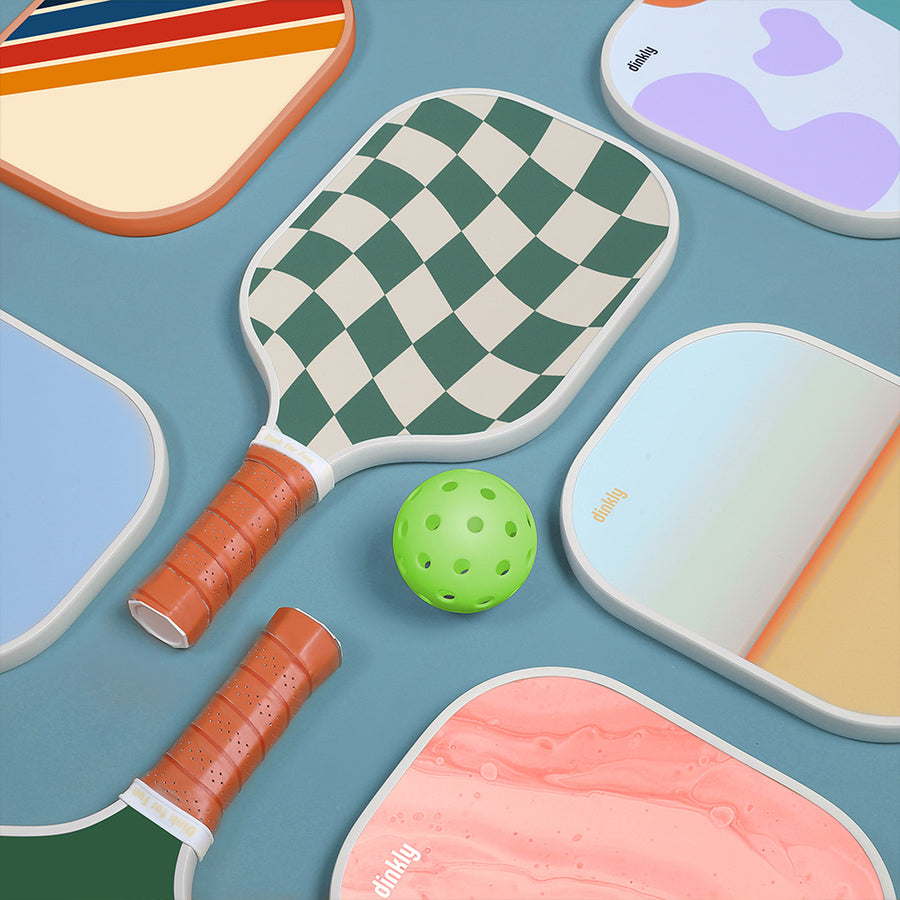
If you need equipment designed to help you learn, browse the Dinkly Beginner Paddles Collection. These paddles offer the perfect blend of control and power, helping keep your shots in bounds while reducing wrist strain as you master the mechanics.
9. FAQ
Q1: How many points do you need to win a pickleball game?
You need 11 points to win a standard game, and you must win by at least 2 points. Some tournaments extend games to 15 or 21 points, but the win-by-two rule always applies.
Q2: What is the two-bounce rule in pickleball?
The two-bounce rule dictates that the ball must bounce once on the receiver's side after the serve, and then bounce once on the server's side after the return. After these two bounces, players can freely volley the ball.
Q3: Can you stand in the kitchen in pickleball?
Yes, you can absolutely stand in the kitchen. The only restriction is that you cannot hit a volley (taking the ball out of the air before it bounces) while standing in the kitchen or touching its lines.
Q4: Can a pickleball serve land on a line?
A serve can safely land on the centerline, baseline, or sideline. However, if it touches the kitchen line, it is a fault.
Leave a comment