


Can You Play Pickleball on a Tennis Court? Yes—Here's How

1. The Short Answer: Yes, You Can Play Pickleball on a Tennis Court
Yes, you can play pickleball on a tennis court. Both sports use the same acrylic hardcourt surface, meaning you can convert an empty court in under 15 minutes with temporary lines and a simple net adjustment.
With roughly 270,000 U.S. tennis courts (Tennis Industry Association) far outnumbering pickleball facilities, temporary setup is the easiest way to avoid crowded courts and get immediate playing time.
2. Pickleball Court vs Tennis Court: Key Differences
Before laying down boundary tape, understanding the core physical dimensions and geometry prevents costly setup mistakes. Here is how pickleball court vs tennis court dimensions compare side by side:
|
Feature / Dimension |
Pickleball Court |
Tennis Court |
|
Court Dimensions |
44 ft x 20 ft (Same for Singles & Doubles) |
78 ft x 27 ft (Singles) / 36 ft (Doubles) |
|
Overall Playing Pad |
30 ft x 60 ft recommended (with run-offs) |
60 ft x 120 ft recommended overall fence area |
|
Net Height (Center / Posts) |
34 inches at center / 36 inches at sidelines |
36 inches at center / 42 inches at posts |
|
Non-Volley Zone (Kitchen) |
7 feet on each side of the net (14 ft total) |
None (Service boxes extend 21 ft from net) |
|
Playing Surface |
Acrylic coated asphalt/concrete or modular tile |
Acrylic hardcourt, clay, or synthetic turf |
Three geometric differences dictate how you play:
Court Footprint (44' x 20'): A pickleball court is roughly one-fourth the size of a doubles tennis court (78' x 36').
Net Height (34" vs. 36"): Pickleball nets hang at 34 inches at the center and 36 inches at the posts—two inches lower at the middle and six inches lower at the sidelines than standard tennis nets.
The Kitchen (7-Foot NVZ): You cannot volley out of the air while touching the 7-foot Non-Volley Zone on either side of the net. To master footwork and avoid common foot faults, read our Pickleball Rules – A Complete Beginner Guide.
3. How Many Pickleball Courts Fit on One Tennis Court?
A standard tennis enclosure measures 60 ft x 120 ft. Because a safe pickleball playing envelope needs roughly 30 ft x 60 ft (including perimeter run-offs), you can fit one to four pickleball courts across a single tennis footprint:
|
Configuration |
Courts |
Net Used |
Best Use Case |
|
1 Centered Court |
1 Court (4 players) |
Existing tennis net (lowered to 34") |
Casual practice, solo drills, 5-minute setup |
|
2 Side-by-Side Courts |
2 Courts (8 players) |
2 Portable nets (perpendicular to tennis net) |
Most popular municipal & social club format |
|
4 Full Quad Layout |
4 Courts (16 players) |
4 Portable nets (2 on each tennis half) |
Tournaments, clinic drills, commercial clubs |

4. Can You Use a Tennis Net for Pickleball?
Yes, you can use a tennis net for pickleball on a centered single-court layout. However, standard tennis nets hang at 36 inches at center—two inches higher than the official 34-inch USA Pickleball specification.
The Quick Fix: Tighten the center strap until the tape reads exactly 34 inches (loosen the post ratchet slightly if the cable is too rigid).
No ATP Shots: A tennis net is 42 feet wide (vs. 22 feet for pickleball), completely blocking around-the-post (ATP) recovery shots.
Elevated Sidelines: Outer posts remain fixed at 42 inches rather than the regulation 36 inches.
Best Alternative: For multi-court layouts or true regulation play, a portable pickleball net ($80–$150) sets up anywhere in under five minutes.

5. How to Mark Pickleball Lines on a Tennis Court
Marking temporary lines is simple if you work methodically. Never use permanent paint on municipal or club courts without written permission. Here is the exact gear and step-by-step procedure:
Essential Tools:
• 50-ft or 100-ft measuring tape
• Blue painter's tape (court-safe, 1.5" to 2" wide) or washable sidewalk chalk
• Corner markers or rubber court lines (for ultra-fast setup without tape residue)
Step-by-Step Marking Guide:
Step 1: Set the Baseline & Sidelines: Measure 22 feet perpendicular from the net on both sides to locate your baselines. Measure 20 feet across for the baseline width, placing a center mark at 10 feet. Connect the corners back to the net to form your 44 ft x 20 ft perimeter.
Step 2: Mark the Kitchen (Non-Volley Zone): Measure 7 feet from the net into each side of the court. Lay down a straight 20-foot line parallel to the net. The zone between this line and the net is your Non-Volley Zone.
Step 3: Lay the Centerline: Connect the 10-foot midpoint of your baseline to the 10-foot midpoint of the kitchen line on each side. This splits the service area into right and left service courts.
The Pro Shortcut (Tennis Service Line Trick): If you want a zero-marking casual game, use the existing tennis service line as your baseline. It sits 21 feet from the net—just one foot shorter than a regulation 22-foot baseline. Place temporary markers for your 7-foot kitchen, and you can begin rallying immediately.

6. How to Set Up a Portable Pickleball Net
If you play side-by-side or quad layouts, portable nets are mandatory. Assembly takes less than five minutes:
Connect the base frame: Lay out the metal base tubes, locking the center T-bracket and lateral leg supports with push-pins.
• Insert vertical posts: Slide the two outer vertical posts into the end brackets.
• Slide the net sleeve: Feed the heavy-duty vinyl net sleeve over both upright poles.
• Insert fiberglass center support: Place the vertical center fiberglass rod directly into the center base bracket to lock the 34-inch height.
• Tension straps: Tighten the top velcro tension straps until the net top cord sits completely taut.
7. How Much Does It Cost to Convert a Tennis Court?
Costs vary dramatically depending on whether you want an afternoon DIY session or an HOA-funded permanent conversion:
|
Conversion Tier |
Estimated Cost |
What's Included |
Permits Required? |
|
Temporary DIY Setup |
Under $25 |
Painter's tape, sidewalk chalk, tape measure |
No (Facility permission recommended) |
|
Permanent Blended Lines |
$200 – $600 per court |
Professional painted lines in contrasting color |
Yes (Facility / Parks Dept approval) |
|
Full Dedicated Conversion |
$15,000 – $45,000+ |
Surface crack repair, acrylic resurfacing, permanent in-ground net posts, fencing |
Yes (City permits & engineering) |
Legal Cautionary Note: Never use permanent paint or aggressive construction tape (like duct tape) on unauthorized courts. In Denver, a player dubbed the "Mayor of Pickleball" faced felony criminal mischief charges after painting permanent lines on public tennis courts. Stick strictly to temporary painter's tape or sidewalk chalk.
8. Rules of Etiquette & What to Know Before You Play
Sharing court space with tennis players requires basic courtesy and surface care:
Pickleball Does NOT Harm Courts: Plastic whiffle balls and composite paddles cause zero structural damage to acrylic hardcourt coatings. Wearing non-marking court shoes produces the same surface wear as regular tennis.
Never Use Duct Tape: Heavy adhesive leaves gummy asphaltic residue that bakes in direct sunlight and peels acrylic paint. Stick strictly to blue painter’s tape or removable vinyl court lines.
Reset Net Height: If you cinch the tennis net strap down to 34 inches, always release it back to the regulation 36 inches when leaving.
Mind Sound Levels: Paddle impacts reach roughly 70 dBA. If the facility borders residential homes, restrict play between 8:00 AM and 8:00 PM to honor neighborhood noise ordinances.
|
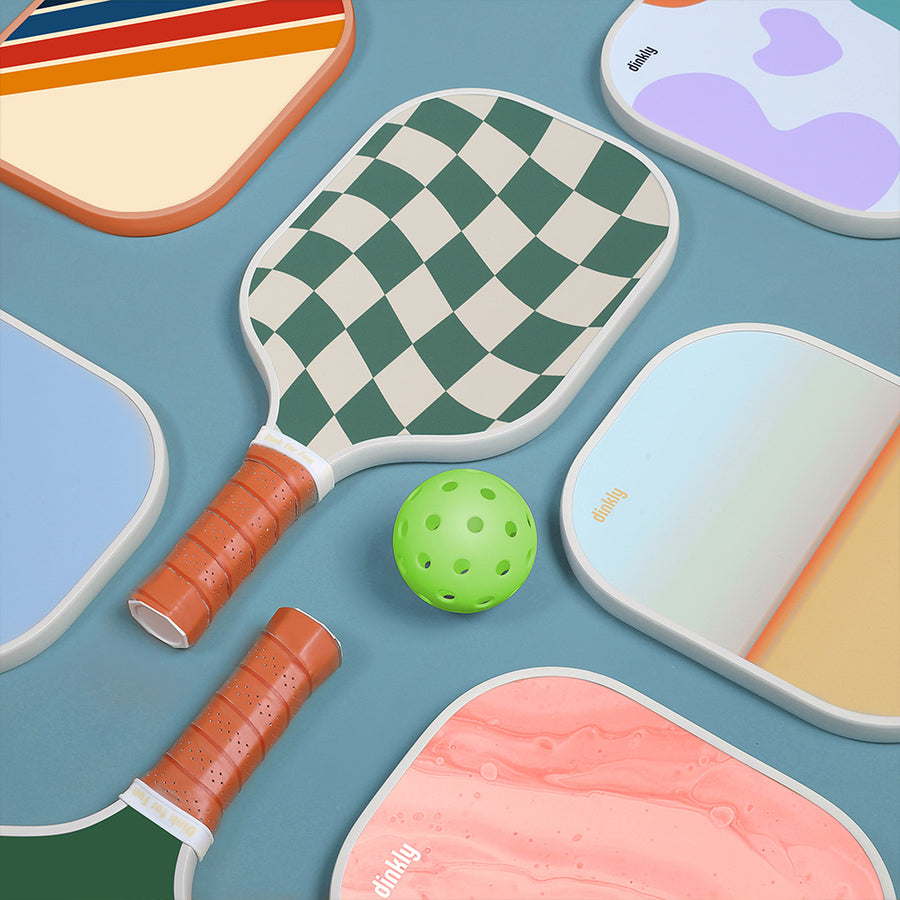
GEAR RECOMMENDATION: READY-TO-PLAY STARTER KITS Setting up a temporary court is only half the battle—having gear optimized for hard surfaces makes all the difference. For families and new players hitting converted tennis courts, the Dinkly Beginner Paddles Collection delivers everything you need in a single carry bag: USAPA-compliant paddles with shock-absorbing 16mm polymer honeycomb cores, durable fiberglass faces, and high-visibility 40-hole outdoor pickleballs engineered for outdoor wind resistance. Want to compare different core technologies? Read our in-depth Complete Pickleball Paddle Buying Guide before choosing your paddle. |
9. Frequently Asked Questions (FAQ)
Q1: Can you play pickleball on a tennis court without painting lines?
Yes. You can use court-safe blue painter's tape, washable sidewalk chalk, or rubber throw-down court lines. These allow you to set up full boundaries in 10 minutes and peel off cleanly with zero surface damage.
Q2: How many pickleball courts fit on one tennis court?
Up to 4 courts. A standard tennis enclosure is 60 ft x 120 ft, while each pickleball court requires about 30 ft x 60 ft with run-offs. You can fit 1 court using the existing net, 2 courts side-by-side, or 4 courts across the full pad.
Q3: Can you use a tennis net for pickleball?
Yes, provided you adjust the center strap down from 36 inches to 34 inches. However, because a tennis net is 42 feet wide rather than 22 feet, it restricts ATP shots. A portable pickleball net offers the best regulation feel.
Q4: Does pickleball damage tennis courts?
No. Lightweight composite paddles and hollow plastic balls exert far less kinetic force than heavy tennis racquets and pressurized balls. As long as players wear non-marking court shoes, pickleball causes zero structural damage.
Q5: What are the dimensions of a pickleball court vs a tennis court?
A pickleball court is 44 ft long by 20 ft wide (net height: 34" center / 36" posts). A tennis court is 78 ft long by 27 ft wide for singles and 36 ft wide for doubles (net height: 36" center / 42" posts).
Conclusion: Hit the Courts Without the Wait
To recap: can you play pickleball on a tennis court? Absolutely. Grab court-safe painter's tape, lower the net strap to 34 inches, and an empty tennis court is ready to play in under 15 minutes. To brush up on strategy before your first match, explore our comprehensive How to Play Pickleball Article.
While setting up lines is straightforward, consistent rallies rely on equipment with forgiving control and shock absorption. Check out the Dinkly Beginner Paddles Collection to gear up with durable, USAPA-compliant paddles and outdoor balls built for hardcourt play.
Leave a comment